HR 360 is the HR command centre for GCC employers. Hire, grow, pay and exit your people on one effective-dated record — with WPS-ready payroll, MoHRE gratuity, Emiratisation quota, document-expiry compliance and employee self-service.
Effective-dated · WPS-ready payroll · Emiratisation quota · UAE labour law
Save a salary change and the old figure is gone. Correct a mistaken hire date and nobody can tell you what the system thought before. Then a ministry, an auditor or a departing employee asks a question about two years ago — and the answer no longer exists.
An in-place edit destroys the previous value. What you can report is only ever "now".
Entitlement typed into a policy table, accruing unchecked for years. The number on the screen cannot be reconciled to the law.
A labour card lapses in a fortnight and nobody sees it coming. The employee cannot legally be on site.
Emiratisation is discovered in a report after the fact, when the hiring decisions are already made.
The problem isn't your HR team. The problem is that the record they work from cannot remember what it knew last year.
Twenty-one pages across eight areas, all reading and writing the same effective-dated record — which is why the leave balance, the payroll line and the org chart can never disagree with each other.
Employees, HR letters, documents and an org chart you can query as of any date.
effective-datedRequisitions, candidates and offers through to onboarding — with visa and mobilisation tracking per hire.
visa trackingPerformance cycles, goals, reviews and training; job architecture with grades, bands and benchmarks; rewards and a merit matrix; succession planning.
successionLeave with per-country policies and a real accrual engine; attendance with shifts, clock-in and Ramadan hours.
30-day statutory leaveRun, lines, approve, process, WPS file, payslips. Loans with schedules, and an end-of-service gratuity calculator.
WPS-readyEmiratisation quota by grade, a 30/60/90-day document-expiry radar, and an immutable audit trail.
quota + expiriesEvery employee signs in to their own view: balances, payslips, documents, attendance and leave requests.
no email chasingBenefits, insurance plans and claims, asset assignment, expense claims, Excel import and multi-entity setup.
multi-entityMost systems hold one version of the truth. HR 360 holds two: when a fact was true in the world, and when the system came to believe it. A salary change, a transfer, a promotion, a back-dated correction — all of them supersede. None of them rewrite.
Non-overlapping effective-dated rows are enforced with exclusion constraints, not application code. Two conflicting truths cannot both be current.
Ask what the organisation looked like on any date and the record answers — because nothing was thrown away to make the current view tidy.
A back-dated payroll fix supersedes the old row and regenerates the WPS file explicitly — as a visible, audited event rather than a silent edit.
Salary, IBAN, Emirates ID and document numbers are stored encrypted at the application layer, not sitting in plain columns.
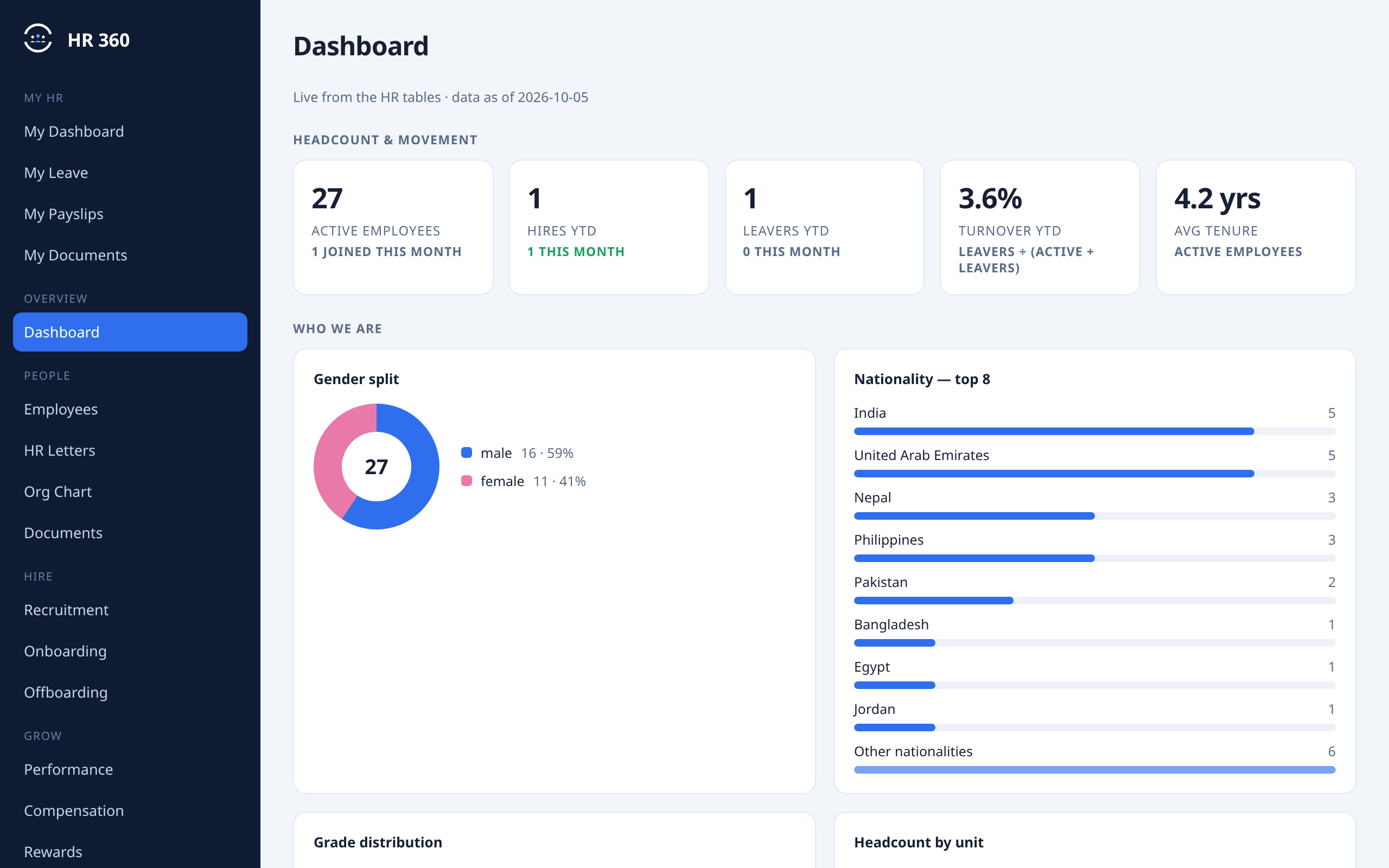
Live values from the demo company — computed from the HR tables, not typed in.
The engine runs the whole lifecycle from the effective-dated record — run, lines, approve, process, WPS file, payslips. But we will not ask you to take that on faith in month one.
Run it alongside your existing process until the numbers match pay cycle after pay cycle with zero unexplained differences — and a local labour-law consultant verifies the gratuity and deduction rules. Until then, it does not go live.
Gratuity and deduction rules live as versioned configuration rather than hardcoded logic, so a rule change is an event you can date, review and roll back — not a code deployment nobody can trace.
Basic pay, allowances, deductions, loans and gratuity are computed from the effective-dated employment record as it stood for that period. A retro correction supersedes rather than overwrites.
September is closed and processed. October is approved and ready to pay. Both are real runs of the same engine, so the numbers on this page are the numbers the payroll module actually produced.
Every figure on this page is read from the running demo company, at the precision shown. Where the system can't be precise it says so instead of pretending, and the numbers that make us look worst — an Emiratisation gap, a negative eNPS, three single points of failure — are all still on this page.
Demo company · October 2026 · figures in AED
Quota, expiries and entitlements, tracked continuously against the law rather than assembled into a report the week before an inspection.
5 of 27 employees are UAE nationals against a 50% target — a shortfall of 31.5 percentage points. Tracked by grade, as of today, instead of discovered in a ministry letter.
Three fall due within 30 days, two more within 60 and one more within 90 — labour cards, visas, Emirates IDs and passports, each with the days remaining on the record.
UAE annual leave is 30 calendar days per year of service. Carry-forward is capped at half of that, and leave may not be allowed to accrue beyond two consecutive years. HR 360 runs the leave year from the hire anniversary and caps the balance at the entitlement — so the number on the employee's own screen is defensible.
Records are appended, not edited. Every change carries its actor and timestamp, alongside the effective-dated history of what the record itself believed at the time.
Leave and gratuity rules vary by emirate, free zone and contract type. HR 360 encodes the federal position; confirm what applies to you with your PRO or legal adviser.
Before shipping, we ran our leave calculation against the statute instead of trusting it. It was wrong: an employee with under five years of service was showing 134 days of annual leave — 137 accrued against a statutory 30 per year, plus an adjustment, minus five used. Nobody had complained, because nobody had checked.
We rebuilt it. The leave year now runs from the hire anniversary, the balance is capped at the entitlement, carry-forward is capped at half, and a new hire inherits nothing. We mention it because a compliance product that won't tell you its own numbers were wrong once isn't really a compliance product.
Verified against Federal Decree-Law 33/2021 and Cabinet Resolution 1/2022, October 2026.
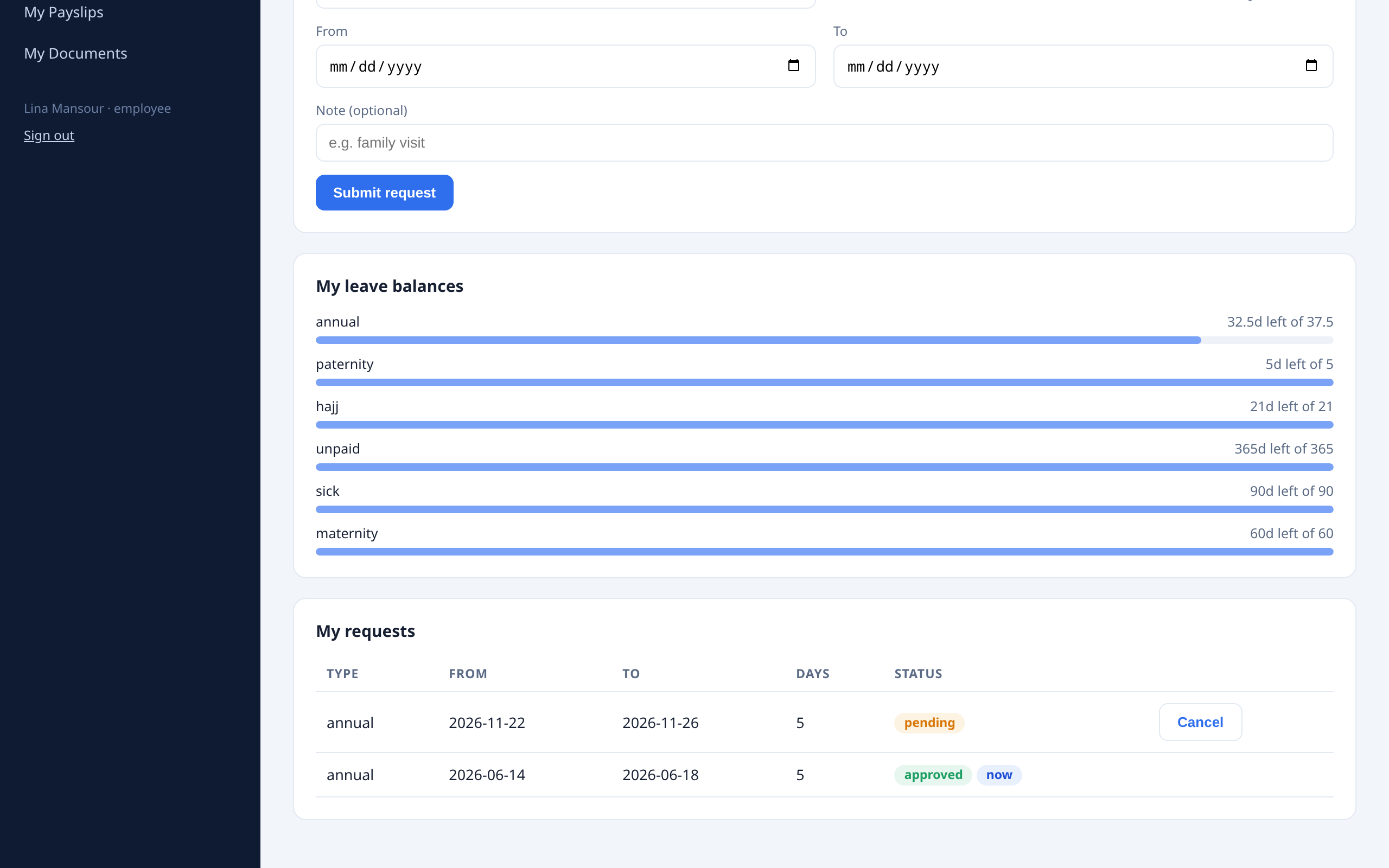
Every employee signs in to their own view — and sees none of the HR console. Balances, payslips, documents and leave requests, answered from the same record HR works from.
Scope comes from the session, never from a parameter. An employee cannot read a colleague's record by changing an id in a URL — and an id that isn't theirs returns not-found rather than someone else's data.
HR 360 reads your own record and surfaces what will cost you — with the rule and the record behind every finding, so you can check the arithmetic instead of trusting a summary.
Critical roles with nobody ready to step in, flagged before the resignation rather than after.
Employees sitting above or below their grade's band, found from the record rather than a manual review.
Expiring documents, leave and expense requests waiting on someone, offers awaiting a decision, onboarding gaps.
Findings above are the demo company's real open insights. The copilots run in a deterministic mode today — no language model is called — so the findings are reproducible and you can check each one against the record. A language layer switches on when a model key is configured.
Personnel records are the most sensitive data a company holds, alongside payroll. They get the treatment that deserves.
Salary, IBAN, Emirates ID and document numbers are encrypted at the application layer rather than stored in plain columns.
Sessions live in HttpOnly cookies with session-bound CSRF protection, and are revocable server-side — deleting the session row kills the token.
Administrator, HR, manager and employee each see what they should. Employee self-service resolves scope from the session, never from a request parameter.
Schema validation on every request and parameterised queries throughout, so a malformed or hostile input can't reach the database.
Records are appended rather than edited, with actor and timestamp, so the question "who changed this and when" has an answer.
The service refuses to start without its secrets instead of limping up with defaults, and schema changes are migration-first.
Monthly or annual. One-time implementation. No per-seat games.
Every plan starts with onboarding: AED 4,000–25,000 one-time — Excel data import, org structure, per-country leave policy, payroll parallel-run support, training.
A live demo of HR 360 on a real dataset — including the parts that don't flatter us.
No sales sequence. One reply from a human.
